Data center growth continues at its projected pace, even as worries about their environmental impacts keep making major headlines. Is there a viable path forward that can assuage those seeking to stop data centers in their tracks while still meeting demand for AI services?
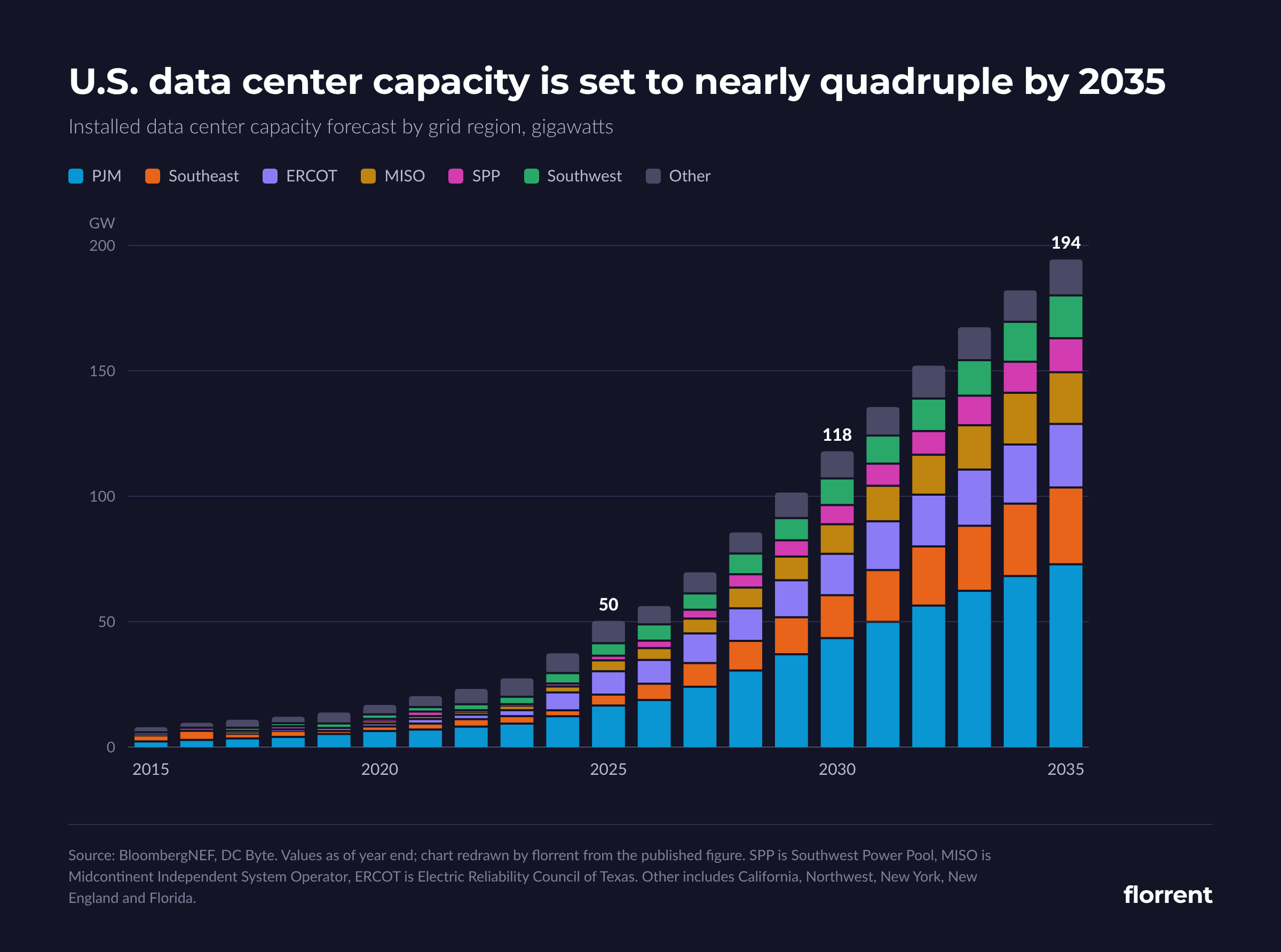
Consider this: BloombergNEF increased its market forecast from about one year ago (December 2025), now estimating data center capacity coming online by 2030 to increase by 52%. By 2035, BloombergNEF now sees an 83% increase from previous forecasts, based on a 100 GW increase in the data center pipeline since last December.
Note that these forecasts were made before Texas and New York started pushing back with regulatory reviews of data center impacts stimulated by environmental (and economic) concerns. Nevertheless, future growth in electricity demand fueled by data centers is unprecedented. As reported at the recent Yotta conference, cumulative AI capex investment is estimated at roughly $11 trillion from 2024 through 2029, with annual spending topping $2 trillion globally by 2028.
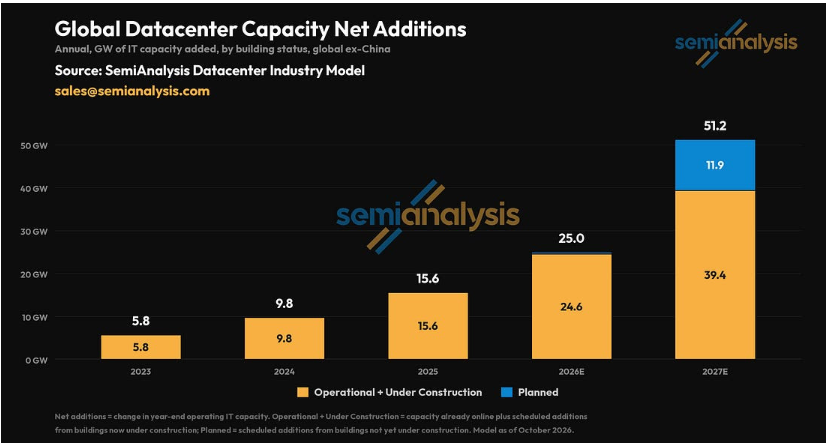
Here are some other staggering statistics from Dylan Patel and his associates at semianalysis:
- An estimated 24.3 GW of new data center capacity is currently under construction at the world’s 40 largest data center campuses.
- As the forecast below illustrates, semianalysis sees 50 GW coming on-line next year!
But there are clouds on the horizon. In a recent poll conducted about the $4 billion data center proposed for Westfield, Massachusetts, 85% of respondents said they were concerned about its environmental impacts. Though these concerns focused primarily on air and water quality, one often unrecognized way to limit the negative environmental impacts of data centers is to build this new infrastructure with components manufactured domestically. This is especially the case when these components are valorizing a natural waste stream, rather than relying on mined materials. This should be a major initial consideration since relying upon products made in the U.S. limits the distance between manufacturing and deployment sites, thereby reducing carbon and other forms of air pollution.
Smart Data Center Energy Storage Strategies to Address On-Site Power Solution Failures
The next step in the journey toward a sustainable data center industry is zeroing in on a design approach that seeks to solve the number-one issue that would help data centers avoid being seen as eco-villains. An issue that has largely flown under the radar for the general public - and even some regulators - is the potential waste disposal catastrophe that could occur if dire projections about failing equipment, namely batteries, generators, and turbines, hold true. Data centers looking to produce their own power since it takes too long to interconnect with utilities could unknowingly contribute to environmental hazards in their speed-to-power push. Failure to recognize this challenge could lead to commercial disasters.
The current rush to tap natural gas fuel as the centerpiece resource for new, hyper-scale data centers has an Achilles' heel, as was exposed in this article. In short, the risk is that these behind-the-meter (BTM), or “off-grid”, assets fail after only 2 or 3 years, creating not only a waste disposal problem, but delays in data center processing. What was viewed as a solution to the utility interconnect delays could result in equivalent delays lasting multiple years, as the backlog of orders for generator parts is also growing due to such high demand.
This is how industry veteran Steve Pullins, formerly of Hitachi and AlphaStruxure and now CEO of ResSET (and who consults regularly with the data center industry), describes the situation:
From my work in data centers, including some transient stability analysis, the large gas turbine generator folks are missing key aspects of AI load profiles. One aspect is that the AI load can ramp at 80 MW/second both up and down. The best turbines and engines can only do 30 MW/minute. So one has to have fast energy storage to sit between AI load and gas turbines/recips to handle that kind of variability. It is hard to convince utilities and turbine/recip vendors of this issue because they haven’t seen it before. (I have…with solar PV variability.) You need a lot of energy (MWh) but do need a lot of fast power (MW). So BESS and electrostatics are great solutions.
The other issue I learned from transient stability analysis is that the AI load profile has a lot of 10-20 MW per few milliseconds variability. Without energy storage standing in between, the variability translates into a lot (180 million of cycles / year) of torque changes on turbine and recip engine shafts. While low amplitude, the number of fatigue cycles is huge. I predict that developers who try to do turbine and recip engine based datacenter power without a smart energy storage strategy will see rotating shaft failures by year three.
He went on to suggest that while li-ion batteries can provide tremendous value to on-site data center power solutions, there remains about 10% of a data center’s daily operating envelope that cannot be typically met by either gas-fired generators or li-ion batteries.
Long duration storage technologies, including hydrogen, have often been described as the holy grail for developing a carbon-free energy system. Yet these technologies require a solution for AI inference data centers at the opposite end of the energy storage continuum: supercapacitors. Similar to flywheels, but better because they are smaller, more modular, and require less operation and maintenance expense, these energy storage devices can provide short-duration, high-power boosts that perfectly match AI spike-load processing.
The de facto across-the-board data center energy storage technology today is lithium-ion (li-ion) batteries, but it is not a Swiss Army knife solution. In fact, li-ion batteries do not address the top threat to power grid integrity: the aforementioned millisecond dramatic spikes in demand. They also present geopolitical risks and, on top of that, impose environmental impacts because the majority of supply comes from China. Even though li-ion batteries reduce on-site power emissions by reducing the scale of fossil fuel generator deployments that currently dominate data center designs, the emissions linked to international transportation routes can still be substantial. In a true life cycle analysis, these li-ion batteries produce emissions that would be greatly reduced if manufactured in the U.S. The opaque data on recycling of li-ion batteries also raises disturbing questions regarding comprehensive and safe waste disposal systems.
Data center operations carry another environmental risk. As noted in this previous florrent article, power quality for the full spectrum of utility customers can be compromised due to a different form of so-called “power pollution.” In this case, power with variations in voltage and/or frequency can increase outages. That, in turn, can lead to greater reliance upon on-site power generators burning dirtier forms of fossil fuel – including diesel or gasoline – sometimes with limited or no pollution controls.
Making The Business Case for Eco-Friendly Data Centers with Supercaps
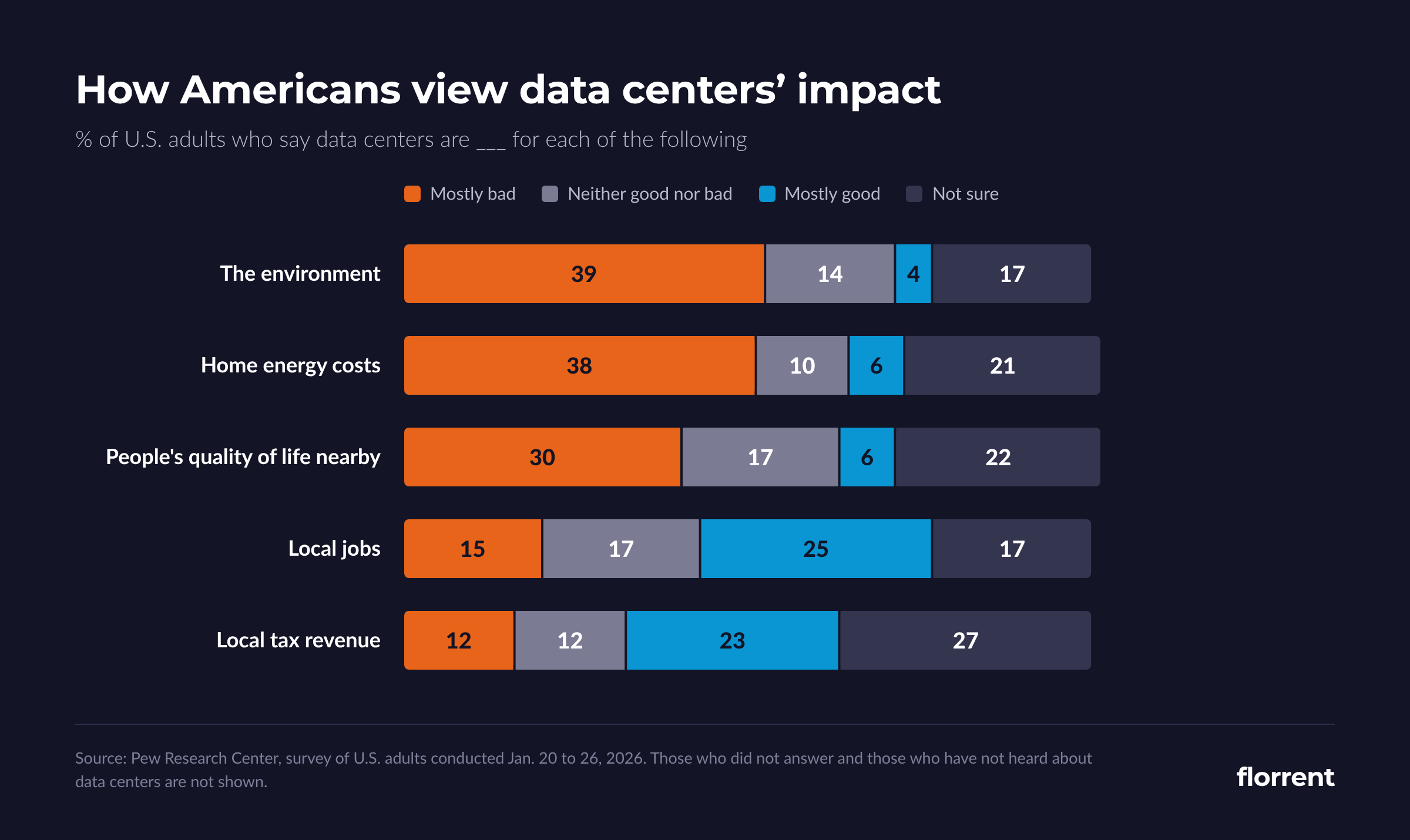
It is clear that communities, and now state regulators, are listening. As noted earlier, both Texas and New York have imposed restrictions on new data center developments based, in part, on concerns about environmental impacts. The following survey highlights that environmental issues just edge out all other impacts, such as rate increases for residential customers, in a recent survey. The chart below from a survey conducted by the Pew Research Center shows that environmental concerns top the list of worries the general public has about data centers.
Supercaps address a myriad of environmental issues. The way to supercharge the eco-benefits of supercaps is to rely upon a technology whose raw material is sourced from the U.S. and whose devices are manufactured domestically. Case in point: the florrent supercapacitor. Built on their Contoured Carbon® material platform, these next-generation supercapacitors use domestically sourced biomass waste diverted from landfill to address GPU whiplash and protect data center assets.
Under a scenario prepared by florrent, it is estimated that over 40 kilotons of biomass could be diverted from landfills every year for every 50 GW of new data center electric supply capacity. This assumes 33 MW of florrent supercapacitors installed per 100 MW of data center load, as forecast by BloombergNEF.
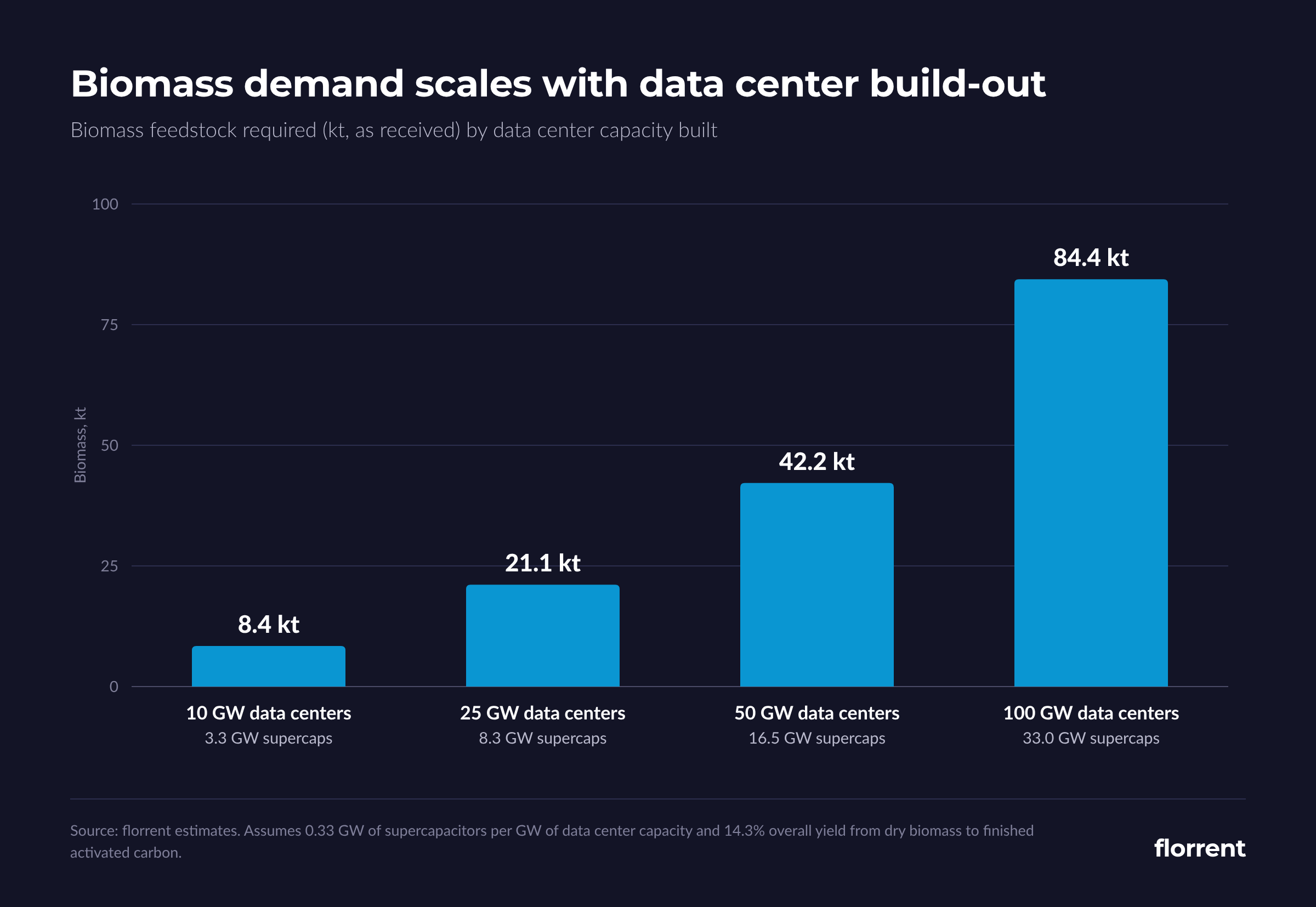
If you step back and look at the bigger picture, domestically sourced and manufactured supercapacitors solve a much bigger problem than grid stabilization.
The value chain used to source and make florrent supercapacitors addresses an issue which has received scant attention, but which can help reverse the narrative that data centers are bad neighbors for communities. In fact, as energy requirements for AI data center racks continue to increase non-linearly (from 100 kW per rack to a forecasted 1 MW per rack within the next two to three years), the increased use of recycled biomass for florrent supercapacitors will have an ever larger environmental impact.
Rather than being viewed as bad actors when it comes to the environment, data centers can actually help become an eco-solution. Along with the waste disposal benefits of technology such as florrent supercapacitors, these energy storage devices can also be a key tool to help maximize reliance upon variable renewable energy sources such as solar and wind for data centers. At present, over 50% of on-site power generation for data center deployments comes from fossil fuels.
Supercapacitors complement and maximize the value of energy storage for data centers looking to build community support for new deployments by leveraging less wasteful and less polluting energy infrastructure. Look for a future florrent article focused on how supercapacitors help build a more resilient and sustainable energy system by helping integrate variable renewable energy resources into data center microgrids as well as the grid network at large.
To sum it all up, supercapacitors help mitigate li-ion battery martyrdom in the AI power smoothing applications. They are not just stabilizing the grid. The story is more profound. Through these massive developments, we are also trying to stabilize the climate.
To learn more about how florrent supercapacitors can serve these applications, please reach out to the florrent team at sales@florrent.com.


