The controversy over the impacts large data centers can have on grid reliability has prompted the Federal Energy Regulatory Commission (FERC) to announce this past June new steps to limit the negative consequences on grid reliability linked to their enormous appetite for electricity.
The order, released on June 18th, initially gave six regional wholesale grid operators 60 days to justify or reform tariffs for data centers to accelerate speed-to-power options in order to limit outages and protect other electricity ratepayers. “We are setting the stage for a resilient, reliable and forward-looking grid that empowers communities and safeguards consumers by transforming the way large energy users access the grid,” said FERC’s Laura V. Swett. “It is also critical that FERC provide certainty for investors by directing the markets to protect existing deals and unlock opportunities for technological advancement and economic expansion,” she continued. One of the end goals, according to FERC, was to compress data center access to power waiting periods to just 90 days.
This article will look at how a specific technology - supercapacitors – can help both these wholesale market regulators and the large load data centers meet the lofty goals expressed by FERC’s leaders. It will also briefly note how Europe is ahead of the U.S. in addressing similar grid integrity issues and how a supercapacitor installation in Germany is serving as a model supercapacitor solution with a front-of-the-meter application.
FERC Order Impacts Six Major U.S. Wholesale Markets
The targeted six grid operators spanning both Independent System Operators (ISOs) and Regional Transmission Organizations (RTOs) are the following:
- Pennsylvania, New Jersey and Maryland (PJM) Interconnection, LLC
- Midcontinent Independent System Operators (MISO)
- Southwest Power Pool (SPP)
- California Independent System Operators (CAISO)
- ISO New England Inc. (ISO-NE)
- New York Independent System Operator, Inc. (NYISO)
Data center operators were largely in favor of this proposed 60-day review. For example, NVIDIA released a statement praising this regulatory review, stating “the actions establish national policy for how America can simultaneously lower energy costs, grow its industrial base, scale AI and strengthen the electrical grid.”
All six control areas, however, asked for another 90-day extension which has delayed their required responses, reflecting, no doubt, the difficulty of accelerating interconnection and resource permitting procedures to meet the FERC requirements, especially when it comes to power quality.
Perhaps one of the most dramatic examples of what FERC is trying to avoid occurred in the PJM control area on July 22nd. More than 3 GW of data center load suddenly disconnected from the grid, which caused a voltage disturbance whose impacts could be felt from the East Coast all the way to the Midwest. The problem originated in Northern Virginia, home to the world’s largest concentrations of data center capacity. The outage lasted 10 minutes and raised concerns about power shortages in the nation’s largest control area. Alarmingly, PJM could face a shortfall of 60 GW in electricity supply over the next decade, according to one estimate. PJM is also facing scrutiny in its approach to supplying data centers with additional capacity, perhaps tilting too much toward large-scale fossil fuels rather than cleaner on-site resources integrated into microgrids.
FERC’s Five Criteria for Accommodating the AI Boom
The six ISO/RTOs need to file new tariffs – or just justify existing programs with tailored options for reforms – that target these FERC concerns about data centers:
- Developing efficient transmission service application and study processes, including consideration of alternative transmission technologies
- Preventing cost shifting and requiring transparency into transmission costs
- Accommodating co-location agreements and behind-the-meter generation
- Providing new transmission services for flexible large loads
- Developing a process to study generating facilities that serve electrically proximate large loads and co-located loads
How can these six major transmission system operators help give a boost to technological solutions such as supercapacitors?
Supercapacitors can be deployed at data center sites to help support and optimize the performance of both gas fired generators and lithium ion batteries. In markets such as PJM, with such significant shortfalls projected for utility-scale projects, much of the power will likely come from behind-the-meter resources. To extend the life of these resources, which can be compromised by gyrating AI processing loads, supercapacitors become an important insurance policy investment. They also offer a number of other important environmental and geopolitical benefits since they are sourced from domestic sources and are manufactured in the U.S. .
Perhaps most important from FERC’s perspective is that supercapacitors can help data centers become good grid citizens. Along with optimizing onsite power serving data centers, supercapacitors can also be deployed to support transmission infrastructure on the other side of the utility meter.
What the U.S. Can Learn from Europe
Europe is ahead of the U.S. in responding to the threat of large load impacts on grid reliability and costs for other utility customers. Regulations are already in place requiring active power management on both sides of the meter. Power flowing from behind-the-meter resources back to the grid needs to be clean as well as power flowing from transmission and distribution networks to customer loads behind-the-meter must also be free of harmonics, voltage and frequency spikes and sags, and other forms of power distortion.
This past May, a report from the European Network of Transmission System Operators for Electricity (ENTSO-E) warned that the continental grid network may have to reduce the penetration of variable renewables unless data center loads become flexibility assets to ensure overall system reliability. The fundamental message of the report is that grid connection codes needed to examine and intelligently regulate ramp-rate limits, oscillation damping, voltage control and reactive power requirements. Among the services ENTSO-E envisions data centers providing include the following: fast frequency response; primary, secondary and tertiary reserves; congestion management and perhaps day-ahead and intraday energy market participation. Note that this kind of relationship to power grids is a major reversal of what data centers envisioned their role would be in the past: a sole focus on self-supply during infrequent grid outages.
Proposed this past June, the EU Cloud and AI Development Act could potentially triple data center loads in Europe within the next five to seven years. Perhaps the best example of how supercapacitors can regulate active power and stabilize the grid as data center loads radically increase throughout Europe is a Siemen’s installation within the control area of TenneT, the largest transmission system operator in Germany. Located in Lower Saxony, a strategic location that sits between variable renewable energy generation facilities such as wind power in the north and large customer loads in the south, Siemen’s so-called E-STATCOM facility features supercapacitors that can stabilize both voltage and frequency. As the world’s energy markets shift away from heavy rotating machinery that comprise massive generation units such as nuclear and coal plants to inverter-based renewables, grids can become less stable. Supercapacitors, which can send quick millisecond bursts of energy, fill the gap with what is often referred to as "artificial inertia.”
Coming Back to FERC
One way to sum up the consequence of the FERC request in the U.S. is that artificial inertia will be called upon to resolve the problems posed by massive expansion of large loads processing artificial intelligence - AI- processes on both sides of the utility meter. The behind-the-meter applications have been examined in previous florrent articles referenced above. In short, they can help extend the life of both natural gas generators and li-ion batteries while enabling data centers to become good grid citizens by offering flexibility services.
In terms of front-of-the-meter applications, the florrent technology has clear advantages, as is illustrated below, lowering both costs and volume. These advantages clearly help address FERC’s focus on affordable solutions for wholesale market transactions spurred on by large load data centers.
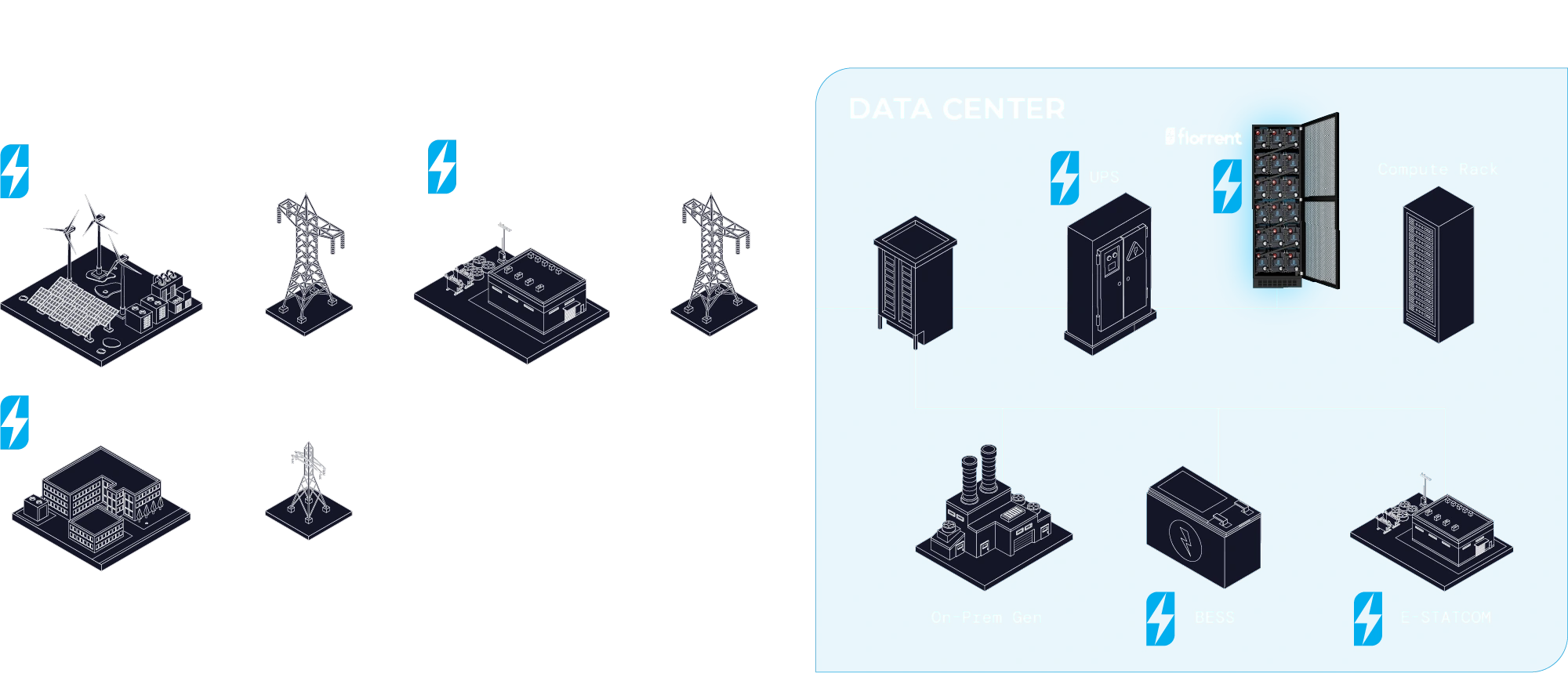
To sum up, the FERC order, and existing and proposed regulations in Europe, showcase the need for new tools to bolster the grid and serve industrial electricity loads that are expanding for the first time in decades. Supercapacitors should be recognized as a key tool to accomplish these goals by transmission and distribution network grid operators – as well as for those developing AI data centers.
To learn more about how florrent supercapacitors can serve these applications, please reach out to the florrent team at sales@florrent.com.


